
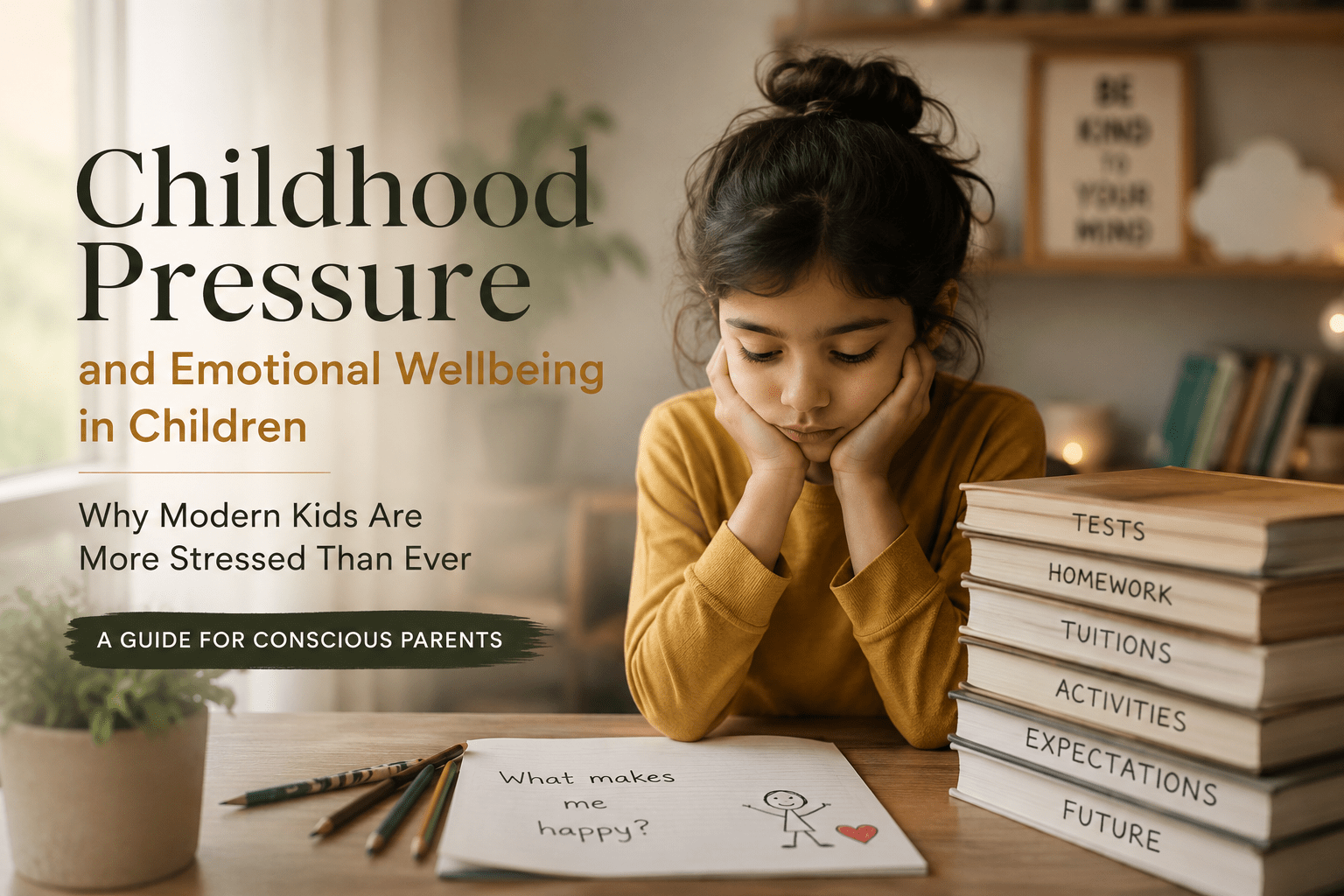
Childhood pressure has become one of the defining challenges of modern parenting. While most parents want the best for their children, growing academic expectations, constant comparison, and performance-focused education are affecting emotional wellbeing in children more than ever before.
Many families are asking the same questions: Are children under too much pressure? How does academic stress affect child development? What can parents do to raise emotionally healthy children without sacrificing educational success?
These questions matter because childhood today looks very different from childhood even a generation ago. Children are growing up in a world of constant evaluation, endless comparison, and increasing uncertainty about the future. Understanding childhood pressure and its impact on emotional wellbeing in children is becoming an essential part of conscious parenting.
Why We Need to Rethink Childhood Today
I don’t remember exactly when childhood became something we started managing so carefully.
Maybe every generation says this about the next one. Maybe parents have always watched children with the same mixture of love and fear, only the language changes.
Still, it feels different now.
You can sense it in ordinary conversations. Someone asks how a child is doing in school, and the room changes slightly. A pause enters the air before the answer comes.
Doing well has become strangely urgent.
A low grade can unsettle an entire household. A teacher’s comment can follow a parent around for days. Even small moments begin carrying too much meaning. A child seems distracted for a week and suddenly people are wondering about attention spans, motivation, and the future.
The future is always hiding somewhere behind these conversations.
I think that’s what makes childhood pressure so difficult to notice at first. It rarely looks cruel. Most of the time, it looks like care. It looks like parents trying to protect a child from uncertainty. It looks like wanting them to have choices, stability, and confidence.
A better life, perhaps.
And yet children can feel the weight of love when it becomes tangled with fear.
Lately I’ve found myself returning to the idea of learning beyond school. Not because school is meaningless. It isn’t. Learning matters deeply. Discipline matters. Effort matters too.
But I keep wondering whether we’ve confused education with performance so completely that we’ve stopped seeing the child underneath it all.
What Is Childhood Pressure?
Childhood pressure refers to the emotional and psychological stress children experience due to academic expectations, social comparison, extracurricular demands, and the fear of falling behind.
Unlike obvious forms of stress, childhood pressure often arrives disguised as encouragement, ambition, or concern for a child’s future. While support and guidance are important, excessive pressure can affect emotional wellbeing in children, confidence, motivation, and long-term mental health.
The challenge is that many children adapt to this pressure before adults recognize it.
Why Childhood Pressure Has Become the New Normal
The strange thing about childhood pressure is that children often adapt to it before adults even recognize it’s there.
A child begins checking whether an assignment will be graded before deciding how much attention to give it. Another hesitates before trying something difficult because they’ve become used to being evaluated. Some children stop enjoying things they once loved simply because those things became measurable.
And the pressure arrives early now.
There are children barely old enough to tie their shoes who are already being assessed, compared, ranked. Parents discuss milestones with the seriousness people once reserved for career decisions. Which school? Which curriculum? Which activities? Which skills will matter ten years from now?
No one really knows, of course.
That uncertainty seems to fuel the anxiety even more.
Technology has intensified it in ways that are difficult to fully explain. Childhood used to contain pockets of privacy. Struggle could remain local, temporary. Now comparison follows families everywhere. School groups, social media, achievement posts, conversations between parents who are themselves exhausted and afraid of getting something wrong.
I sometimes think the modern education system has quietly convinced parents that childhood is a race happening at all times.
The problem with races is that somebody always appears behind.
And once a child starts feeling behind, even rest begins to feel undeserved.
What Emotional Wellbeing in Children Actually Looks Like
When people speak about emotional wellbeing in children, they often describe confidence, positivity, and resilience.
But the children who seem emotionally healthiest to me are not always the happiest ones.
Sometimes they are the children who feel safe enough to fall apart.
The child who cries after a difficult day without apologizing for it. The child who admits they are scared instead of pretending not to care. The child who can fail at something and still believe they are loved afterward.
That last part feels important.
Many children grow up quietly linking affection with performance. Not because parents intend to create that connection, but because achievement receives so much attention. Pride becomes loud. Disappointment becomes heavy. Over time, children begin reading emotional weather very carefully.
You can see it in the way some children look at adults after making mistakes. They are not only reacting to the mistake itself. They are checking whether the relationship still feels safe.
Emotional wellbeing in children is difficult to measure precisely because it lives in these small invisible moments.
It develops slowly, almost privately.
A child learns whether it is safe to ask questions.
Whether confusion is embarrassing.
Whether struggle changes how they are seen.
Whether home is a place where they can arrive unfinished.
I don’t think emotional wellbeing comes from constantly protecting children from discomfort. Life eventually brings disappointment to everyone. The healthier children seem to be the ones who trust they won’t face those disappointments alone.
Why Academic Success Is Not the Only Measure of Child Development
I sometimes think about the children everyone admired in school.
The ones adults pointed toward as examples.
Usually what people admired was clarity. High marks create a very clean story around a child. They reassure everyone. Teachers feel successful. Parents feel relieved. The child learns that achievement brings approval quickly and predictably.
But adulthood has a way of complicating those stories.
Some children who seemed exceptional early on struggle later with anxiety, perfectionism, or a fear of failure so intense that it quietly shapes their entire lives. Others who appeared average in school slowly become remarkable adults because they learned things school never really measured well in the first place.
Curiosity.
Patience.
The ability to recover after disappointment.
The ability to stay interested in the world.
I keep returning to a question that feels embarrassingly simple: if grades disappeared tomorrow, what would we notice about a child?
Not theoretically. Truly.
Would we notice how kind they are to younger children? The questions they ask when nobody is evaluating them? The way they become absorbed in certain subjects for no practical reason at all?
Maybe that is where we begin to learn beyond school.
Not by rejecting academics, but by refusing to believe that marks alone can explain a human being.
The older I get, the more suspicious I become of anything that claims to measure a child completely.
Homeschooling and Alternative Education: Are They Right for Every Family?
Conversations about homeschooling and alternative education often become strangely ideological.
People want certainty. They want one approach to be clearly better than the others, as though raising children could ever be solved that neatly.
But children themselves resist neatness.
For some families, homeschooling creates room for a child to breathe again. Learning slows down. Curiosity returns. A child who was shrinking inside constant comparison begins to feel visible in a different way.
For other families, homeschooling would create stress, isolation, financial strain, or emotional exhaustion.
The same complexity exists with alternative education models. Montessori schools, Waldorf approaches, democratic schools — each one is built around different assumptions about child development and learning. Some children thrive inside those structures. Others don’t.
I don’t think the real question is whether traditional schooling or alternative education is objectively superior.
The real question is quieter than that.
What kind of environment allows this particular child to remain curious about the world without becoming afraid of themselves?
Sometimes the answer lies outside the conventional education system.
Sometimes it doesn’t.
I’ve met children in traditional schools who felt emotionally secure because home remained a place of steadiness rather than pressure. I’ve also met children in progressive environments who still carried enormous anxiety because performance simply found new disguises.
No educational philosophy completely frees us from being human.
How the Education System Shapes Child Development
Most education systems are built around standardization because they have to be.
There are too many children, too many classrooms, too many moving parts for education to function entirely around individual pacing.
Still, I wonder what happens to children when they spend years inside systems that treat development as something linear.
Same age.
Same benchmark.
Same timeline.
Children almost never grow that way.
One child may read advanced books while struggling emotionally. Another may understand people beautifully yet take longer academically. Some children bloom late. Some burn out early. Some move confidently in one environment and completely lose themselves in another.
Yet the education system often leaves little room for unevenness.
And so many children quietly absorb the belief that struggling in one area means something is fundamentally wrong with them.
I think about this often because adults carry those feelings for years. Sometimes decades.
A child who was called slow begins approaching life cautiously long after the label should have disappeared. Another who was praised constantly becomes terrified of losing that identity.
Perhaps one of the kindest things we can tell children is that development is uneven.
Human beings are uneven.
There is no universal timeline for becoming yourself.
Conscious Parenting: Raising Emotionally Secure Children, Not Just High Performers
The phrase conscious parenting can sound intimidating at first.
It sounds like something people with endless patience might practice successfully.
I don’t think that’s true.
If anything, conscious parenting seems to begin with noticing how often fear enters the room before we realize it has arrived.
A child comes home with disappointing grades and suddenly a parent is no longer reacting only to the grades themselves. They are reacting to imagined futures. Missed opportunities. Their own childhood experiences. Their own fears about failure.
Children rarely inherit anxiety through lectures.
They absorb it through the atmosphere.
Which is uncomfortable to admit.
I think conscious parenting asks parents to become curious about their reactions instead of immediately trusting them. To pause long enough to ask:
Is this response coming from the child’s actual needs, or from my fear about what their future might become?
Sometimes children need guidance.
Sometimes they need limits.
And sometimes they simply need someone to sit beside them long enough for disappointment to feel survivable.
The parents who stay with me are rarely the perfect ones. They are the ones willing to reconsider themselves. The ones willing to apologize. The ones willing to separate their child’s worth from the child’s performance, even when the world keeps encouraging them to confuse the two.
That separation is harder than it sounds.
Especially inside cultures where achievement is treated almost like proof of good parenting.
How Parents Can Support Emotional Wellbeing in Children
While every family is different, a few principles seem to appear repeatedly in emotionally healthy environments:
- Praise effort, curiosity, and persistence—not just outcomes.
- Allow children to make mistakes without treating them as personal failures.
- Create space for rest that is not tied to productivity.
- Encourage questions, uncertainty, and exploration.
- Avoid constant comparison with siblings, classmates, or friends.
- Make it clear that love does not become stronger after success or weaker after failure.
None of these eliminate childhood pressure entirely.
But they help children build a healthier relationship with themselves.
A Space to See Children More Closely
The longer I think about childhood pressure, emotional wellbeing in children, homeschooling, alternative education, conscious parenting, child development, and the education system, the more they seem connected by the same quiet fear.
What if the child doesn’t succeed?
Most parenting anxiety eventually circles back to that question.
And maybe that’s why the idea of learning beyond school stays with me.
Not because it dismisses ambition or discipline or academic effort.
But because it asks a different set of questions alongside them.
Not only: How is the child performing?
But also: Who is the child becoming while performing?
Are they curious?
Do they feel safe enough to fail?
Can they rest without guilt?
Do they know they are loved on ordinary days, not just successful ones?
I don’t think there are perfect answers here.
Every educational approach solves one problem while creating another. Every parent carries fears they are trying not to pass down. Every child surprises us eventually, often in ways no report card could have predicted.
Perhaps that uncertainty is not something we can remove from parenting.
Perhaps the task is simply to remain close enough to children that we do not lose sight of them beneath all the measures.
That feels harder now than it should.
And maybe more necessary than ever.
Frequently Asked Questions
What is childhood pressure?
Childhood pressure refers to the emotional stress children experience due to academic expectations, social comparison, extracurricular demands, and fear of failure.
How does academic pressure affect children?
Academic pressure can contribute to anxiety, perfectionism, reduced self-esteem, fear of failure, and lower emotional wellbeing in children when expectations become overwhelming.
What is emotional wellbeing in children?
Emotional wellbeing in children refers to a child’s ability to express emotions, cope with challenges, build healthy relationships, and maintain a sense of safety and self-worth.
Can homeschooling reduce childhood pressure?
For some families, homeschooling reduces comparison and performance-based stress. However, it is not the right solution for everyone and depends on a child’s needs and family circumstances.
What is conscious parenting?
Conscious parenting is an approach that encourages parents to become aware of their own fears, expectations, and reactions so they can respond more thoughtfully to their children’s needs.